
Why childcare centres need more than a daily wipe: residual surface protection for high-contact classrooms
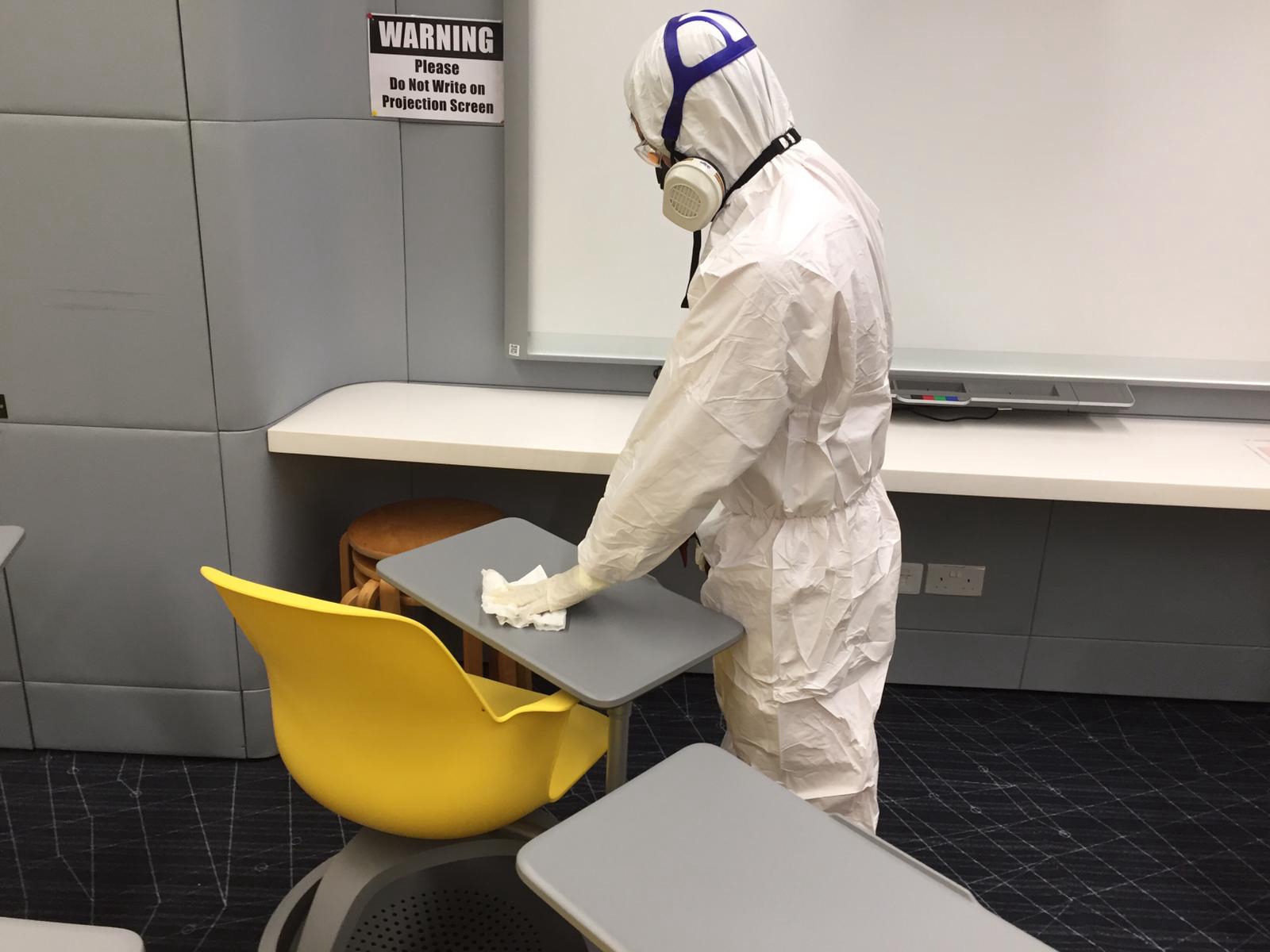
A childcare centre is one of the most demanding environments for surface hygiene we work in. Children touch everything: door handles, tabletops, cot rails, toy bins, light switches. They touch each other. Then they touch their faces. A wipe-down after morning session is essential, but it is only clean for a few minutes.
The harder problem is what happens in between. A surface disinfected at 8 a.m. has no residual protection by 9 a.m. once a dozen small hands have been across it. That gap, not the clean itself, is where cross-contamination takes hold. For centre directors managing MOM licensing requirements and NEA audit season, this is worth understanding before it becomes a complaint or an outbreak.
This is the case we make to every preschool and childcare operator we visit: daily disinfection is necessary, but it is not sufficient on its own. The surfaces that children contact most need a layer of protection that stays active between cleans.
Why this matters: In a high-contact childcare environment, surfaces become recontaminated within minutes of being wiped, so protection that only lasts as long as the cleaning product is wet leaves children and staff exposed for most of the day.
Highlights
- Daily wiping removes contamination at that moment; it offers no protection once dry
- The AEGIS Microbe Shield is a silane quaternary-ammonium micropolymer that bonds permanently to treated surfaces and keeps working between cleans
- It mechanically ruptures the cell membranes of bacteria, mould and fungi on contact, without leaching or dissipating
- Effective on plastic, wood, metal, glass and textiles: the full range of surfaces in a classroom
- Treatments are field-verifiable with a simple BPB test, so you have documented proof for audits
- Approved under Health Canada PCP# 15133, US EPA reg. 64881-1 & 64881-7, EU PT-7 & PT-9 (REACH) and UK PT-2
The recontamination problem daily cleaning cannot solve
Why a wipe is clean only while it is wet
Conventional disinfectants, whether alcohol-based sprays, dilute bleach solutions or quaternary ammonium wipes, kill or remove microbes on contact. The moment the product dries, the surface is inert again. The next child who touches it deposits whatever is on their hands, and the surface is contaminated until the next scheduled clean.
In a childcare classroom running from 7 a.m. to 7 p.m., surfaces may be wiped once or twice a day. That leaves hours of unprotected contact time, particularly on the surfaces children use most: tabletops, chair arms, toy storage, cot rails, door handles and bathroom taps. Staff cannot realistically wipe every surface after every child interaction.
What the research says about childcare settings
Childcare centres are acknowledged transmission environments for a range of illnesses. Research on hand, foot and mouth disease outbreaks published in Emerging Infectious Diseases specifically identified preschool settings as a key focus for cleaning and disinfection measures, noting the importance of repeated environmental cleaning of premises and articles at preschool centres. Singapore has seen its own significant HFMD seasons, and the pattern holds: the harder the surfaces are worked, the faster contamination returns after a clean.
This is not a criticism of hardworking childcare staff. It is a structural limitation of any disinfection-only approach. Cleaning removes what is there. It cannot prevent what arrives next.
How residual antimicrobial protection works differently
The mechanism: a coating that stays active, not a spray that dries off
The AEGIS Microbe Shield coating works on a different principle entirely. It is a silane quaternary-ammonium micropolymer that bonds chemically to the surface it is applied to, forming a positively-charged coating that persists after the application dries. When a microbe lands on the treated surface, the coating ruptures its cell membrane on contact: a mechanical action, not a chemical one.
Because the coating is non-leaching, it does not dissipate, wash off in normal cleaning or get used up through contact. It keeps working between cleans for the life of the treated surface. For a childcare setting, this means every tabletop, cubby handle, toy shelf and cot rail continues to inhibit the growth of bacteria, mould and fungi in the hours between each scheduled clean.
What surfaces it covers
A typical childcare classroom has a wide variety of surface materials, and a residual coating is only useful if it works across all of them. The AEGIS Microbe Shield bonds effectively to:
- Plastic (toy storage, chairs, cot rails, light-switch plates)
- Wood (tables, shelves, furniture, door frames)
- Metal (door handles, handrails, tap fittings, cabinet hardware)
- Glass (windows, internal glazing panels)
- Textiles (soft furnishings, floor mats, fabric toy bins, curtains)
A single treatment programme can cover the entire classroom environment rather than selecting only hard surfaces.
Verification: proof you can show an auditor
One practical concern for operators facing NEA or MOM inspection is documentation. Claiming a surface has been treated is one thing; proving it is another. AEGIS Microbe Shield treatments can be field-verified using a bromophenol-blue (BPB) test, which confirms the coating is present on the surface. That verification is something you can record and show.
For more on how this field test works, see the AEGIS Microbe Shield field detection guide.
When a coating helps and when remediation comes first
A residual coating protects the surfaces it is applied to. It is not a substitute for dealing with an active contamination problem, and it will not fix a mould source or a water leak.
If a childcare classroom has visible mould growth on walls, ceiling tiles or soft furnishings, that needs proper mould and bacteria remediation before any coating is applied. Coating over active mould does not resolve the underlying growth; it only delays a larger problem. Singapore's humidity and building construction mean mould can establish quickly in low-airflow areas, particularly after the monsoon months.
Similarly, if a facility has a persistent damp issue, the source needs to be identified and corrected. A coating protects a clean, dry surface. It cannot compensate for ongoing moisture ingress.
For centres that are structurally sound and simply looking to close the gap between daily cleans, a coating programme is a straightforward and well-proven step. We assess each facility on-site before recommending a programme, because conditions vary: room size, ventilation, surface materials and how the space is used all affect what a treatment looks like.
For comparison, the table below shows what daily disinfection and an antimicrobial coating each provide, and what neither can do alone.
|
|
Daily disinfection |
AEGIS Microbe Shield coating |
Neither alone |
|---|---|---|---|
|
Removes contamination at time of clean |
Yes |
No (not a cleaning agent) |
, |
|
Active protection between cleans |
No |
Yes |
, |
|
Works on all surface materials |
Yes |
Yes |
, |
|
Non-leaching, residual for surface life |
No |
Yes |
, |
|
Field-verifiable |
No |
Yes (BPB test) |
, |
|
Fixes active mould or water source |
No |
No |
Remediation required |
For context on how other operators across different sectors use this approach, the Branksome Hall case is a useful reference: an educational setting that applied the coating specifically to protect high-touch areas.
You can also read a broader overview of childcare centre disinfection and antimicrobial infection-control methods to see how the methods compare across different threat types.
For centres considering a disinfection service alongside a coating programme, we can combine both in a single visit: an initial professional disinfection to start from a clean baseline, followed by the coating application.
Frequently asked questions
Is the coating safe for young children?
Yes. Once the coating has cured and the room has been aired, it is safe for normal use. The silane quaternary-ammonium micropolymer bonds to the surface and does not leach, transfer or off-gas. It is non-leaching by design, so there is no ongoing chemical release that children could be exposed to through touch or inhalation.
Will normal daily cleaning damage or remove the coating?
No, routine cleaning with standard products will not remove the coating. It is bonded chemically to the surface rather than sitting as a layer on top of it. Abrasive scrubbing or very aggressive chemical stripping could degrade it over time, but standard wipe-down with a dilute disinfectant, which is what most childcare centres use, leaves it intact.
How do we know the coating is still working?
Treatment can be confirmed at any time with a simple BPB (bromophenol-blue) field test, which shows whether the positively-charged coating is present on the surface. We recommend documenting this at treatment and at any subsequent re-assessment, so you have a verifiable record for audit or inspection purposes.
Does the coating replace our existing disinfection routine?
No, and we would not recommend that. Daily disinfection removes dirt, organic matter and fresh contamination, which the coating does not do. The coating provides residual antimicrobial protection in the intervals between cleans. The two approaches are complementary: keep your cleaning routine and let the coating hold the surface safer in between.
How long does a treatment take, and when can children return to the room?
Treatment time depends on the size and complexity of the facility, but a typical childcare classroom can be treated in a few hours. We schedule around the centre's operating hours where possible. The room needs to be well-ventilated during and after application; we advise on the appropriate re-entry time on the day, based on conditions.
A treated surface is a genuinely more defensible surface, not just a cleaner-looking one. For operators who are accountable for the health and safety of young children, that distinction is what a daily wipe alone cannot provide.
Ready to protect your classrooms between cleans?
Contact Aegis Asia to discuss a coating programme for your centre. Request a quote, call us on 6241 9443, WhatsApp 9222 9222, or email info@aegisasia.com.
Get a free quote