
Why office disinfection alone isn't enough: the case for residual surface protection between cleans
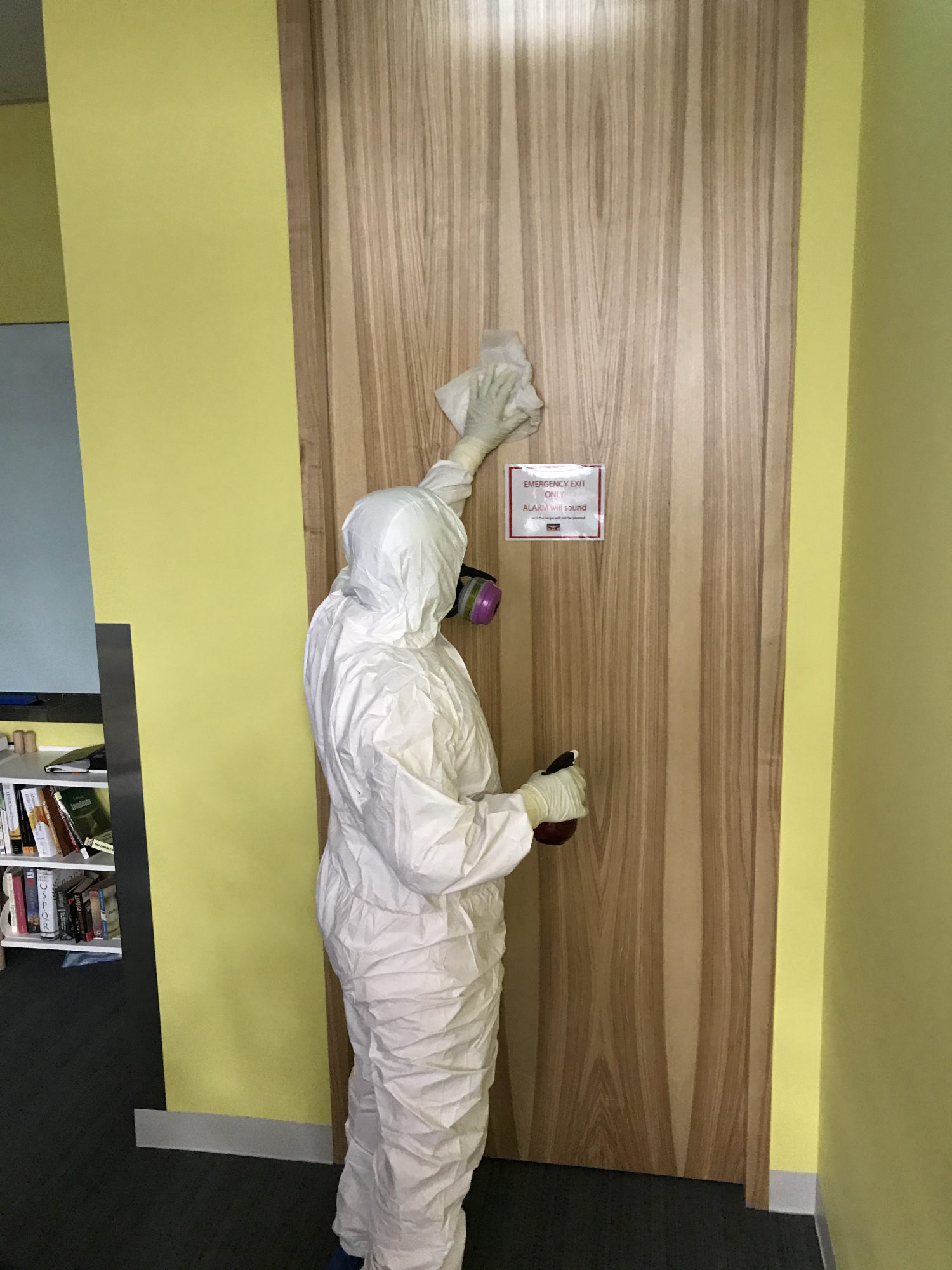
Your office gets disinfected on a schedule. The crew arrives, wipes down the desks, treats the door handles, and leaves. For a short while, the surfaces are clean. Then the first person touches the lift button on the way up, and the clock resets.
This is the coverage-lapse problem. It is not a failure of the disinfection crew, it is a structural gap in how routine cleaning and disinfection work. A biocide applied to a surface kills what is there at that moment. The moment it evaporates, the surface is open again. In a busy Singapore office with shared workstations, AV equipment and communal pantries, that window closes fast.
For facilities managers juggling cleaning contracts, audit requirements and staff expectations, understanding that gap is the difference between a surface that looks clean and one that is actually protected.
Why this matters: A standard disinfection visit eliminates surface contamination at the moment of treatment, but leaves no residual protection, so every touch after the crew leaves starts rebuilding the bioburden your next clean has to deal with.
Highlights
- Routine disinfection removes surface contamination in the moment but offers no residual protection between visits
- High-touch surfaces in offices, door handles, lift buttons, keyboards, shared AV remotes, recontaminate within minutes of a clean
- The AEGIS Microbe Shield is a silane quaternary-ammonium micropolymer that bonds permanently to a surface and ruptures microbes on contact
- Non-leaching and non-dissipating: the coating does not wash off, wear out or get used up between cleans
- Protects plastic, wood, metal, glass and textiles; field-verifiable by BPB test
- Approved under Health Canada PCP# 15133, US EPA reg. 64881-1 & 64881-7, EU PT-7 & PT-9 (REACH) and UK PT-2
The surfaces that recontaminate fastest, and why
Not every surface in an office carries the same risk. A painted wall that nobody touches is very different from the door handle that 80 people grip between 8 am and 6 pm. Facilities teams know this intuitively, but it is worth being specific about which surfaces reset the fastest, because those are the ones where the gap between scheduled cleans does the most damage.
The highest-recontamination surfaces in a typical Singapore office are:
- Door handles and push plates, touched by every person entering or leaving a room, dozens of times per hour
- Lift buttons, shared across entire floors and buildings, with no way to control frequency of contact
- Shared keyboards, mice and touchscreens, hot-desking setups compound this significantly
- Meeting-room AV remotes and conference phones, passed hand to hand, rarely wiped between sessions
- Pantry surfaces and kettle handles, high contact, often with wet hands, which accelerates transfer
- Toilet door handles and tap fittings, self-evident, but often last on the wipe-down list
Singapore's Environmental Sanitation guidelines for high-risk non-healthcare premises identify high-touch surfaces as the primary contamination pathway in shared spaces, noting that routine cleaning and disinfection operations should target these areas as a baseline, not a ceiling. That framing matters: a baseline clean is the minimum, not the complete answer.
Why the cleaning schedule can't keep up
Even a rigorous office disinfection service in Singapore, daily, thorough, using the right biocides, faces a simple arithmetic problem. If a door handle is touched 50 times between each wipe-down, the surface is contaminated 49 times before the crew gets back to it. The disinfectant used in routine cleans is consumed on contact: once it neutralises what is on the surface at that moment, it is gone.
The result is a sawtooth pattern: the bioburden on a surface drops to near zero after each treatment, then climbs steadily back until the next one. In a low-traffic space, that slope is gradual. In a busy open-plan office or shared meeting room, the climb is steep and fast.
What residual protection actually does differently
The AEGIS Microbe Shield works on a different principle entirely. Rather than applying a biocide that kills on contact and then dissipates, it is a silane quaternary-ammonium micropolymer coating that bonds covalently to the surface itself, forming a permanent, positively-charged layer that mechanically ruptures the cell membranes of bacteria, mould and fungi on contact.
The critical difference is that the coating does not get used up. It is non-leaching: it does not transfer to the next hand that touches it, does not wash off during routine cleaning, and does not dissipate as a conventional disinfectant does. The surface remains active between cleans, not just immediately after them.
For a facilities manager, this changes the model. Rather than relying entirely on the frequency of your disinfection service visits to keep surfaces safe, the treated surface itself contributes to protection in between. The scheduled clean still matters, it removes soil, dead microbes and organic debris, but you are no longer starting from zero protection the moment the crew leaves.
What the coating works on
The AEGIS Microbe Shield bonds to a wide range of office surfaces:
- Plastic, keyboard housings, handset bodies, lift button panels, AV remotes
- Metal, door handles, handrails, tap fittings, equipment casings
- Glass, touchscreens, glass partitions, display panels
- Wood, desk surfaces, cabinet handles, meeting-room furniture
- Textiles, chair upholstery, soft partitions, fabric wall panels
That coverage matters in an office environment where a single high-touch zone, say, the meeting-room door, table, remote, and shared screen, spans four or five different substrate types.
Verifiable, not just claimed
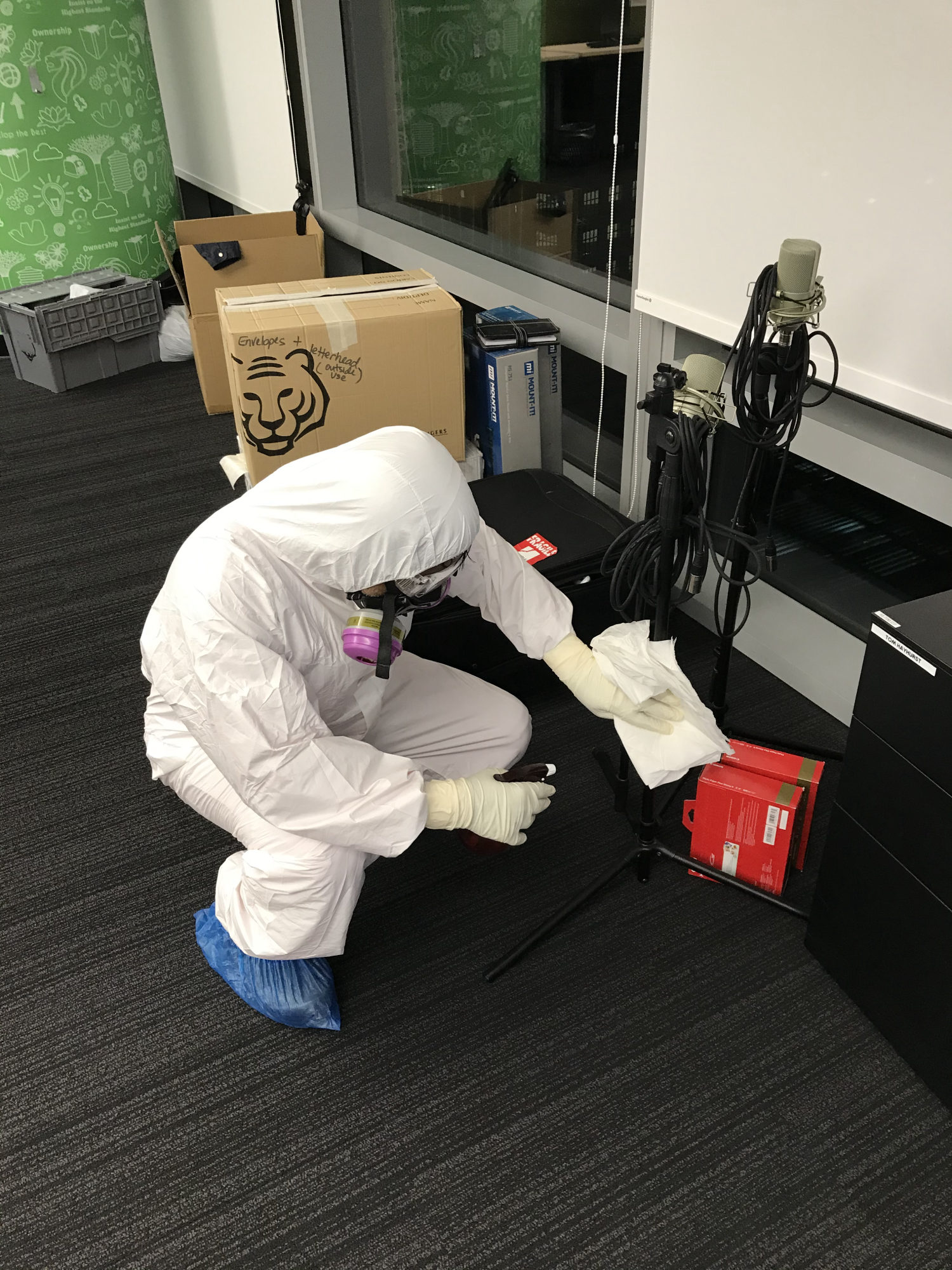
One thing that distinguishes a properly applied AEGIS Microbe Shield treatment from a surface that has simply been wiped with a disinfectant spray is that it can be field-verified. The bromophenol-blue (BPB) test confirms the coating is present and active on the surface. You are not taking the technician's word for it. That kind of verifiability matters when you are accountable to building management, a facilities audit, or an infection-control requirement.
For further background on how field detection works in practice, the AEGIS Microbe Shield field detection article covers the BPB method in detail.
When disinfection alone is the right answer, and when it isn't
To be direct: there are situations where a one-off or scheduled office disinfection service is exactly what is needed, and Aegis provides that too. If your office has had a confirmed contamination event, or you need to meet a regulatory or FM audit requirement before reopening a space, a thorough disinfection visit is the right first step.
The same applies if there is an active mould or contamination source, a water-damaged ceiling tile, a leaking pipe behind a wall panel. No surface coating protects against an ongoing source. The source has to be dealt with first, typically through mould and bacteria remediation, before a protective coating makes sense.
Where a periodic-only approach falls short is in the high-traffic, shared-surface environment that most Singapore corporate offices actually represent. If your cleaning contract runs to two or three visits a week, and your staff are in the building five days a week touching the same door handles and keyboard trays, the gap between visits is where the risk accumulates. That is the gap residual coating closes.
A practical way to think about it: disinfection clears the surface; the AEGIS Microbe Shield keeps it working between clears. The two complement each other rather than compete. Several high-traffic institutional settings have adopted this combination approach, from transit authorities protecting shared vehicle surfaces to corporate campuses treating high-touch common areas. The principle is consistent regardless of sector: a busy shared space accumulates contamination faster than a scheduled clean alone can address.
The honest limit, to set expectations correctly
The AEGIS Microbe Shield protects the surfaces it is applied to. It does not create a sterile environment, and it does not replace routine cleaning, soil and organic debris still need to be removed mechanically. What it does is ensure that a treated surface is not simply inert between cleans, waiting to accumulate whatever it contacts next. Results depend on the surface, how it is used, and the level of foot traffic, but the non-leaching, residual mechanism is consistent and verifiable.
Frequently asked questions
Will the AEGIS Microbe Shield coating wash off when cleaners wipe down surfaces?
No. The coating bonds covalently to the surface rather than sitting on top of it, so routine wiping and cleaning does not remove it. It is designed to coexist with your existing cleaning programme, the clean removes soil and debris, and the coating keeps working on the surface underneath. That is the point of a non-leaching treatment.
How do we know the coating is actually still active on a treated surface?
Treatments can be field-verified using the bromophenol-blue (BPB) test, which confirms the presence and activity of the coating on the surface. This is one of the features that sets the AEGIS Microbe Shield apart from a conventional disinfectant spray: you are not relying on memory of when it was last applied.
Which office surfaces benefit most from a residual coating?
The highest-value surfaces are the ones touched most frequently by the most people: door handles, lift buttons, shared keyboards, meeting-room AV equipment, pantry fittings and toilet hardware. These recontaminate fastest after a standard disinfection visit, so residual protection between cleans makes the most practical difference there.
Can a surface be coated if it already has mould or an active contamination issue?
Not without dealing with the source first. If mould is present or there is an ongoing moisture or contamination source, remediation comes before coating. Applying a protective layer over an active problem does not address the underlying cause. Once the source is resolved, the coating provides residual protection on the treated surface going forward.
Is the AEGIS Microbe Shield safe for use in occupied offices?
Yes. Once applied and dry, the coating is non-leaching, meaning it does not transfer to skin or release into the air during normal contact. It is approved under Health Canada PCP# 15133, US EPA reg. 64881-1 & 64881-7, EU PT-7 & PT-9 (REACH) and UK PT-2, and is used in occupied settings including schools, transit vehicles and commercial offices.
The real question for most facilities managers is not whether to disinfect, that is a given. It is whether the protection they are paying for stops the moment the cleaning crew's van pulls out of the car park. For high-touch surfaces in a busy Singapore office, the answer to that question matters more than the cleaning schedule does.
Ready to close the gap between cleans? Request a quote or get in touch with us directly: call 6241 9443, WhatsApp 9222 9222, or email [email protected].
Get a free quote