
The charge that kills: how a positively-charged surface coating ruptures bacteria on contact
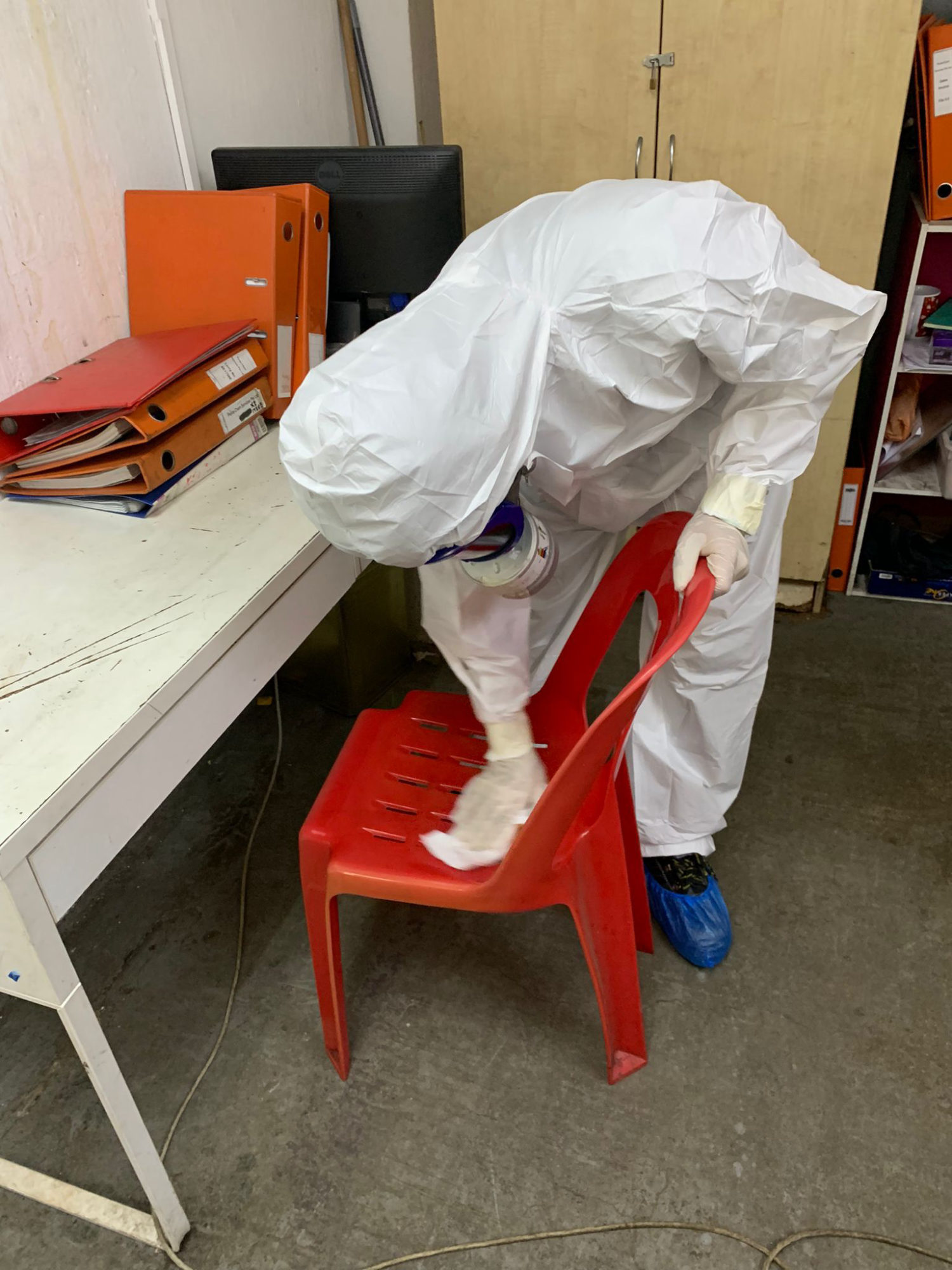
A facilities manager asked us a fair question recently: 'You say it kills bacteria on contact, but so does every spray on the shelf. What actually makes yours different?' It is a good challenge, and it deserves a real answer, not a brochure line.
The short answer is the mechanism. Most conventional disinfectants work by releasing a chemical that poisons microbes. The active ingredient gets used up or rinses away, and once it is gone, the surface is unprotected again. What the AEGIS Microbe Shield does is physically different: it bonds to the surface, stays there, and ruptures bacteria by force rather than by chemistry.
If you are trying to decide whether antimicrobial surface coating is genuine science or just marketing, the mechanism is exactly what you should be asking about.
Why this matters: a surface that actively ruptures bacteria between cleans gives you residual protection that a spray-and-wipe routine cannot, and the chemistry behind it is verifiable on site.
Highlights
- The AEGIS Microbe Shield is a silane quaternary-ammonium micropolymer that bonds permanently to the treated surface
- It forms a positively-charged coating that mechanically ruptures the cell membranes of bacteria, mould, fungus and their allergens on contact
- Non-leaching: it does not dissipate, transfer or get used up, giving residual protection between cleans for the life of the treated surface
- Works on plastic, wood, metal, glass and textiles
- Treatments are field-verifiable on site by the bromophenol-blue (BPB) test
- Approved under Health Canada PCP# 15133, US EPA reg. 64881-1 & 64881-7, EU PT-7 & PT-9 (REACH) and UK PT-2
The chemistry: what 'positively-charged' actually means
Bacteria, mould spores and fungal cells carry a negative charge on their outer membranes. This is not incidental, it is a basic fact of microbial biology, and it is the basis for how the AEGIS Microbe Shield works.
The silane quaternary-ammonium compound in the coating bonds to the surface substrate and then forms a dense array of long molecular chains. Each chain carries a positive charge at its tip. When a negatively-charged microbe contacts the surface, it is drawn to those positively-charged tips by electrostatic attraction.
What happens next is mechanical, not chemical. The molecular spikes physically pierce and rupture the microbe's cell membrane. The cell cannot survive structural failure of that kind. There is no chemical poison involved, and because the coating is not releasing any agent into the environment, the active structure stays intact.
This distinction, contact-kill rather than release-kill, is well-documented in antimicrobial polymer research. As that PMC review notes, contact-based antimicrobial coatings work by chemically grafting biocides onto surfaces rather than relying on diffusion of a released agent, which means the antibacterial activity does not depend on a depleting reservoir. That is precisely what non-leaching means in practice.
Why 'non-leaching' matters for your premises
A leaching product releases its active ingredient into the surrounding environment. That gives you a brief burst of activity, but the product is consuming itself every time it acts. Rinse the surface, clean it, or simply wait long enough, and protection is gone.
The AEGIS Microbe Shield does not leach. The molecular structure bonds covalently to the surface, so there is nothing to wash away. This is why we describe the protection as residual: the treated surface keeps rupturing microbes on contact between your regular cleans, not just immediately after treatment. For a high-traffic clinic corridor or a shared office kitchen, that continuity of protection is the whole point.
You can read more about how the AEGIS Microbe Shield coating differs from conventional disinfectants, and how the full treatment process works from application to verification.
What it protects against and what it treats
The coating ruptures bacteria, mould, fungus and the allergens these produce. It is effective on a wide range of substrates: plastic, wood, metal, glass and textiles. That means you can apply a single consistent programme to door handles, handrails, desk surfaces, upholstered seating, and hard floor trims in the same visit.
This breadth matters in settings like childcare centres, where classrooms carry a mix of soft and hard high-contact surfaces, or in food-premises environments where biofilm builds on counters and equipment alike. Our biofilm on food-prep surfaces article covers why a daily wipe routinely misses what is actually growing on those surfaces.
The surfaces where we see the most demand
In Singapore's dense, high-traffic buildings, the highest-risk points are consistently:
- Lift buttons and handrails
- Door handles and push plates
- Shared desk and workstation surfaces
- Clinic reception counters and waiting-area seating
- Childcare and school furniture and play equipment
- Food-prep counters and cold-room surfaces
- Public transport seating and grab rails
The coating has been applied in all of these settings. The AEGIS Microbe Shield has been used by transit authorities and schools precisely because the non-leaching structure holds up under the kind of repeated contact and routine cleaning that would deplete a conventional product quickly.
Field verification: the BPB test
One of the most common questions we get from facilities managers is: 'How do I know the coating is actually there and still working?' It is the right question to ask of any antimicrobial surface treatment.
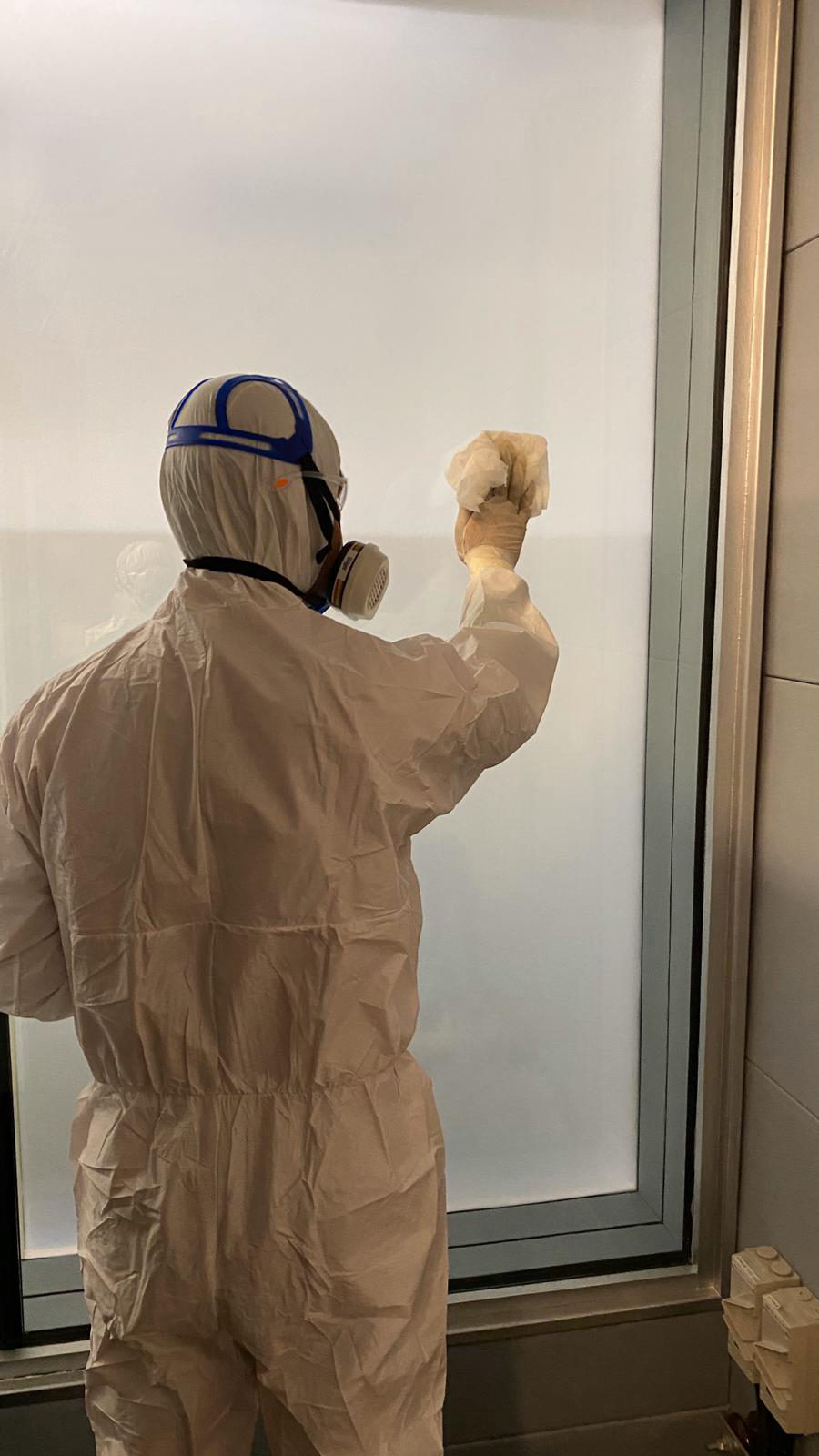
The answer for the AEGIS Microbe Shield is the bromophenol-blue (BPB) test: a simple field-verification method that can be carried out on the treated surface on site. The BPB indicator reacts to the positive charge left by the coating. A colour change confirms the coating is bonded and active; no change indicates the surface needs re-treatment. This is not a lab-only result; it is something we can demonstrate during a site visit or a scheduled maintenance check.
No conventional spray disinfectant offers anything comparable. You apply it, it evaporates or gets wiped away, and there is no way to confirm residual protection is present. With the AEGIS Microbe Shield, the positive charge is the proof.
When antimicrobial surface coating is the right step, and when it is not
The coating works on the surface it is applied to. It cannot fix an active mould problem at source, and it is not a substitute for dealing with water ingress, damaged seals, or a drainage issue that is already driving visible contamination. If a surface has active mould growth, mould remediation comes first: the root cause has to be addressed before a protective coating makes sense.
For surfaces that are structurally sound and clean but need continuous residual protection between regular cleans (which describes most commercial and institutional premises in Singapore) the AEGIS Microbe Shield is the appropriate solution. Our disinfection service can also be scheduled alongside or before coating for premises that need an initial deep-clean baseline.
Where there has been a confirmed contamination event, bio-decontamination is the starting point, not surface coating alone.
Regulatory approvals and what they confirm
The AEGIS Microbe Shield's non-leaching, contact-kill mechanism has been reviewed and approved by four major regulatory bodies: Health Canada PCP# 15133, US EPA reg. 64881-1 & 64881-7, EU PT-7 & PT-9 (REACH) and UK PT-2. These approvals cover the product's efficacy and safety profile, and they confirm that the mechanism has been evaluated by independent authorities, not just claimed by the manufacturer.
For a sceptical facilities manager or a clinic operator comparing antimicrobial surface coating options, the approvals are a concrete way to distinguish chemistry that has been tested from marketing that has not. You can review the supporting data in our technical library.
The science behind the coating is also the reason it carries a child-safe and food-contact-safe profile: because the coating does not release a chemical agent, the risk profile is fundamentally different from that of a leaching biocide.
Frequently asked questions
How does antimicrobial surface coating actually kill bacteria?
The AEGIS Microbe Shield is a silane quaternary-ammonium micropolymer that bonds to the surface and forms a dense array of positively-charged molecular spikes. Bacteria carry a negative charge on their outer membranes, so they are attracted to those tips. The spikes physically rupture the cell membrane on contact. There is no chemical poison: the kill mechanism is entirely mechanical.
Will the coating wash off when we clean the surface?
No. The silane bond is covalent, meaning the coating grafts chemically to the substrate rather than sitting on top of it. Routine cleaning with standard commercial products does not remove it. The BPB field test can confirm the coating is still active at any point after treatment.
How does this differ from a regular spray disinfectant?
A spray disinfectant releases a chemical agent that kills on contact and then dissipates. Once the active ingredient is gone, the surface has no protection. The AEGIS Microbe Shield does not release anything: it sits on the surface and ruptures microbes mechanically, every time a microbe contacts it, for the life of the treatment.
Is the coating safe to use in food-prep areas and clinics?
Yes. Because the coating is non-leaching, it does not release any chemical agent into the surrounding environment. It has been applied in food-premises, healthcare settings, childcare centres and schools. The regulatory approvals under Health Canada, the US EPA and EU REACH confirm the safety profile has been independently assessed.
Does the coating stop mould as well as bacteria?
The AEGIS Microbe Shield ruptures bacteria, mould, fungus and their allergens on contact. However, if a surface already has active mould growth driven by water ingress or a structural issue, the source problem must be resolved first. The coating protects a clean, sound surface between cleans; it is not a substitute for mould remediation where an active problem already exists.
Speak to us about protecting your premises
If you would like to know whether the AEGIS Microbe Shield is right for your facility, we are happy to advise. Request a quote, call us on 6241 9443, WhatsApp 9222 9222, or email info@aegisasia.com.
Get a free quote